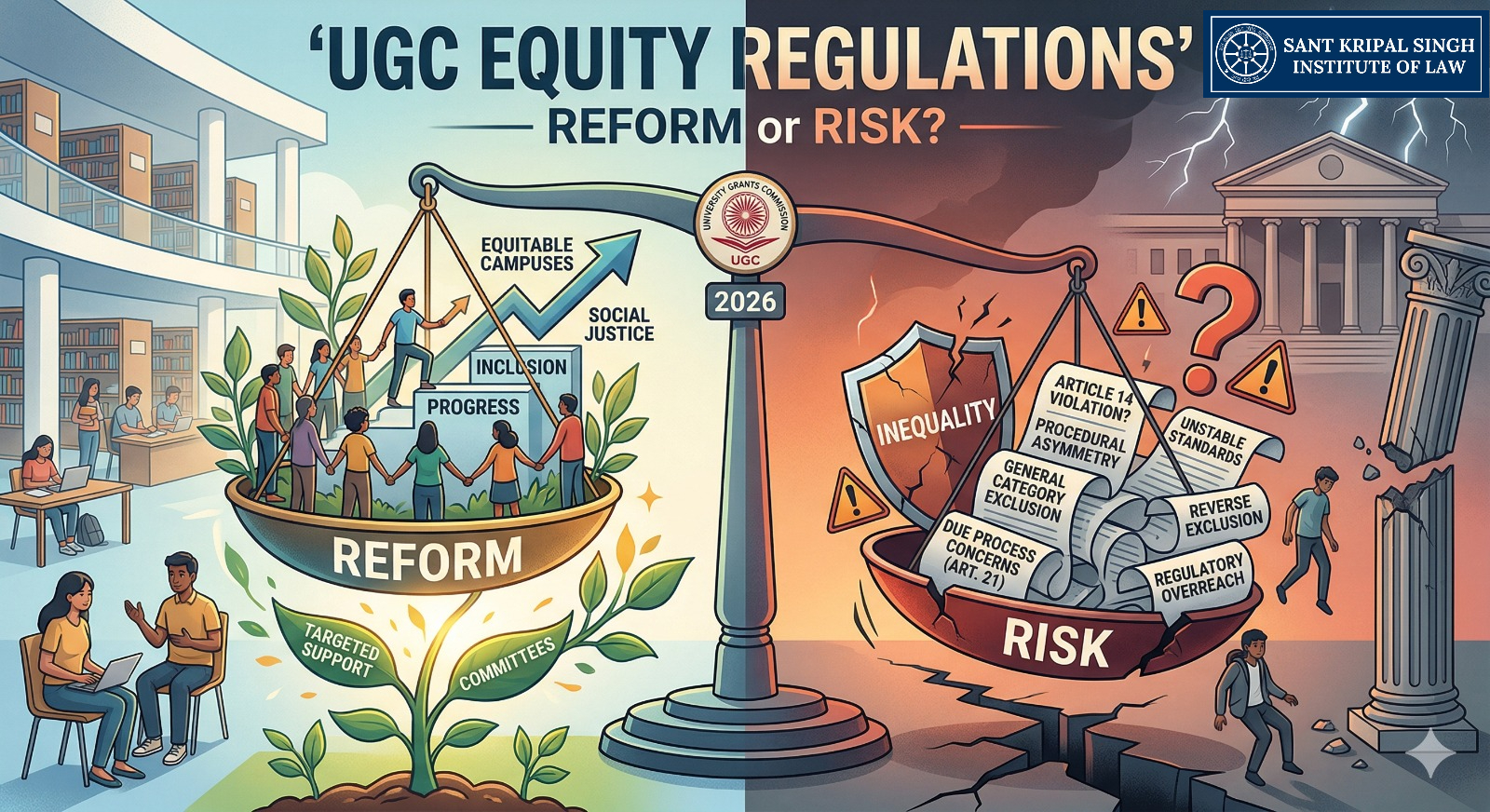
The 2026 Equity Regulations issued by the University Grants Commission aim to curb discrimination in higher education institutions through specialized enforcement mechanisms. While the stated objective is inclusion and protection of marginalized groups, the framework has attracted criticism for creating unequal legal coverage and procedural imbalance. This article critically examines how the Regulations may adversely affect the rights of general category students, raising concerns under Articles 14, 15, and 21 of the Constitution of India, and the doctrine of equal protection of laws.
Introduction
Anti-discrimination regulation in higher education is both necessary and constitutionally supported. However, when regulatory frameworks adopt selective protection models without universal procedural balance, they risk violating the very equality principles they seek to enforce. The UGC Equity Regulations, 2026 attempt to institutionalize equity enforcement through committees, monitoring bodies, and complaint systems. Yet, their structural design and definitional scope have generated serious legal debate — particularly regarding the exclusion or weak protection of general category students facing discrimination. A regulation intended to prevent injustice must itself withstand the test of constitutional fairness.
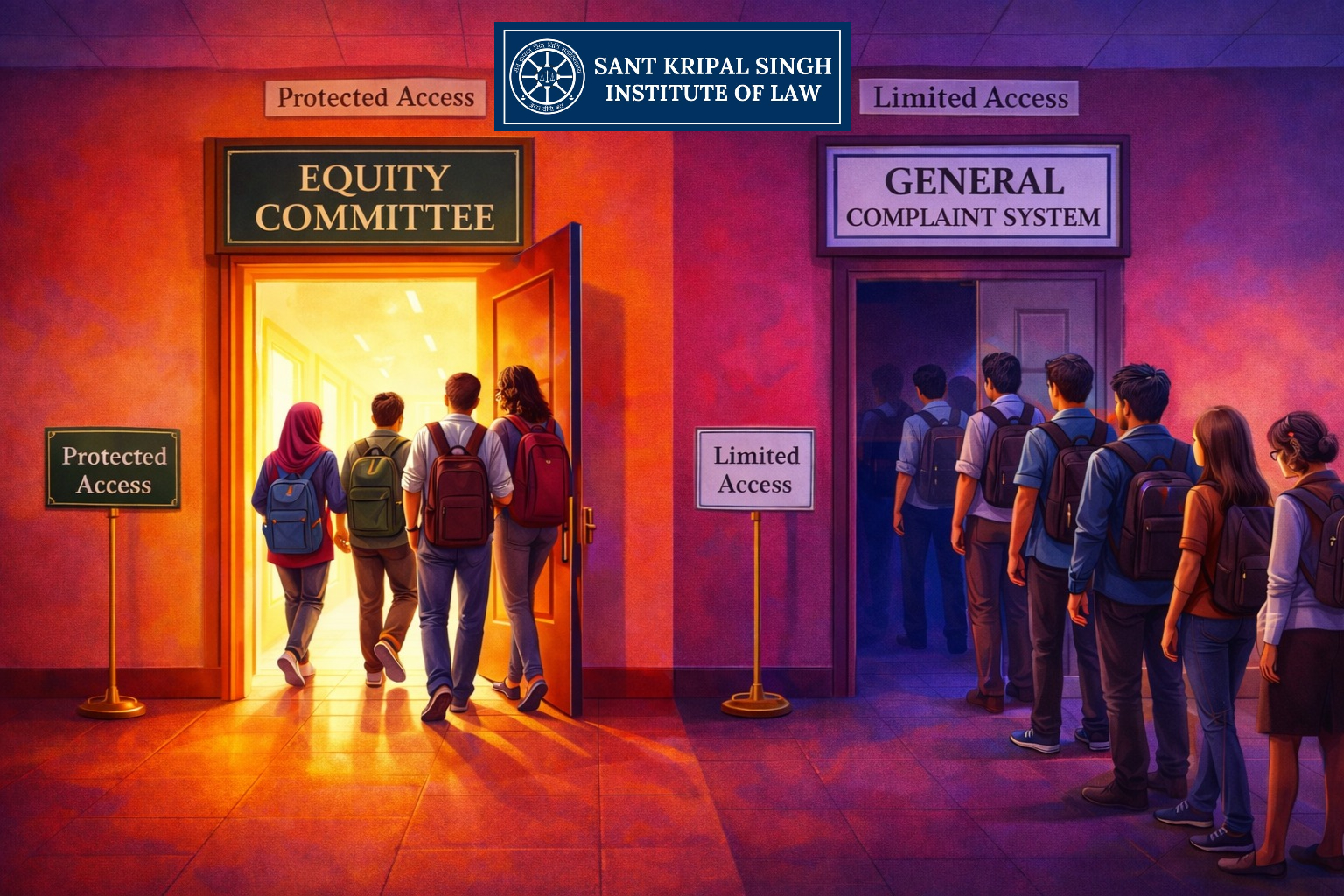
Core Structure of the Regulations
The Regulations mandate that universities establish Equal Opportunity Centres, Equity Committees, and complaint redressal mechanisms focused primarily on caste-based and social discrimination affecting specified communities. Institutions are placed under strict compliance duties, backed by regulatory consequences.
While protective targeting is not per se unconstitutional, constitutional jurisprudence requires that any classification must be:
- Based on intelligible differentia, and
- Have a rational nexus with the objective sought to be achieved (Article 14 test).
The present framework is criticized for failing the second limb when it results in denial or dilution of remedy for similarly situated victims outside listed groups.
Article 14 — Equality Before Law and Equal Protection
Article 14 guarantees both equality before law and equal protection of laws. The second limb is crucial — it requires that legal remedies remain accessible to all persons similarly affected by wrongdoing. If a regulatory complaint structure recognizes discrimination only when suffered by specified social categories — while offering no equivalent channel for general category victims of comparable misconduct — the protection becomes asymmetrical. Such asymmetry may be challenged as under-inclusive and constitutionally suspect. The Supreme Court of India has repeatedly held that classification cannot become exclusion when the harm addressed is universal in nature.
Article 15 — Non-Discrimination Principle
Article 15 prohibits discrimination on grounds of religion, race, caste, sex, or place of birth. While Articles 15(4) and 15(5) permit special provisions for socially and educationally backward classes, these are enabling — not exclusionary — clauses. They allow additional protection; they do not justify withdrawal of protection from others. A regulatory model that structurally centers only certain identity categories in complaint recognition — without parallel channels for others — risks converting protective discrimination into regulatory discrimination.
Due Process and Procedural Fairness Concerns
Beyond classification, procedural design raises additional concerns:
- Absence of clear standards of proof in discrimination findings
- Broad and open-ended definitions open to subjective interpretation
- Limited safeguards against motivated or strategic complaints
- Strong institutional penalties without proportionate adjudicatory safeguards
Under Article 21, any framework that affects reputation, academic standing, or institutional access must follow fair, just, and reasonable procedure. Regulatory enforcement without tight procedural guardrails may fail this due process threshold.
Risk of Reverse Exclusion in Campus Justice
A paradox emerges: a rule designed to reduce exclusion may unintentionally create reverse exclusion in grievance recognition. General category students who experience harassment, bias, or caste-linked targeting may find themselves outside the specialized redressal framework — forced into slower, generic channels while others receive fast-track institutional mechanisms. Equality law does not oppose targeted support — but it opposes remedy denial.
Autonomy, Over breadth, and Regulatory Overreach
The Regulations also expand compliance surveillance inside campuses through committees, monitoring roles, and reporting mandates. Without narrowly tailored jurisdiction and transparent standards, such bodies risk evolving into disciplinary authorities without statutory adjudicatory structure — raising concerns of regulatory overreach and chilling effects on academic environments. Regulation must correct discrimination — not centralize unchecked discretionary power.
Conclusion
The Equity Regulations, 2026 pursue a constitutionally legitimate objective — inclusive and discrimination-free campuses. However, constitutional validity depends not only on purpose but also on design. A framework that narrows recognition weakens procedural symmetry, and sidelines equally placed victims risks violating Articles 14, 15, and 21. True equity regulation must be inclusive in protection, precise in definition, and fair in procedure. Otherwise, the pursuit of social justice may unintentionally erode equal protection — the very foundation of constitutional governance.
~Varun Rai (Assistant Professor)
Join SKSIL Law College and gain hands-on experience with the latest legal technology.