This article examines the fine distinction between judicial activism and judicial adventurism within the framework of the Indian Constitution. It explores the evolution of activism through landmark cases, analyzes instances where courts may have crossed constitutional limits, and highlights the need for judicial self restraint to preserve the separation of powers.
Introduction
The judiciary is often called the sentinel on the qui vive—the vigilant guardian of the Constitution. In fulfilling this responsibility, Indian courts have occasionally gone beyond mere interpretation and taken a proactive stance in shaping public policy and protecting fundamental rights. This phenomenon, celebrated as judicial activism, has expanded the reach of justice. However, when judicial interventions begin to blur the constitutional demarcation between the judiciary and other organs of the State, they risk turning into judicial adventurism. The present article seeks to explore this delicate balance.
Evolution of Judicial Activism in India
Judicial activism is premised on the belief that the Constitution is a living document, requiring flexible and purposive interpretation.
- Constitutional Interpretation: The landmark judgment in Kesavananda Bharati v. State of Kerala (1973) introduced the basic structure doctrine, demonstrating the judiciary’s resolve to preserve constitutional supremacy.
- Expansion of Fundamental Rights: In Maneka Gandhi v. Union of India (1978), Article 21 was interpreted broadly to include the right to live with dignity, signifying a turning point in Indian constitutional jurisprudence.
- Rise of Public Interest Litigation: The 1980s saw the judiciary transform into a forum for the poor and marginalized, as seen in Hussainara Khatoon v. State of Bihar (1979), which secured the right to speedy trial for undertrial prisoners. Judicial activism has thus acted as a catalyst for social change, ensuring that the constitutional promise of justice is not merely theoretical but practical.
Judicial Adventurism: Crossing the Boundary
Judicial adventurism, in contrast, refers to instances where courts enter areas constitutionally reserved for the legislature or executive. It is characterized by judicial decisions that amount to law-making or governance rather than interpretation. Examples often cited include:
- Judicial directions on complex policy matters like river-linking projects or pricing of natural resources.
- Interference in administrative appointments beyond the constitutional framework.
- Striking down constitutional amendments without sufficient constitutional justification.
Such interventions, critics argue, may erode the doctrine of separation of powers and disturb the equilibrium envisioned by the Constitution.
Constitutional Framework and the Need for Restraint
The Constitution provides for a system of checks and balances. While Articles 32 and 226 empower courts to enforce rights, they also implicitly require judicial discipline. The judiciary must act to protect constitutional values but avoid substituting its own wisdom for that of elected representatives. The Supreme Court, in Divisional Manager, Aravali Golf Club v. Chander Hass (2007), explicitly cautioned against judicial overreach, observing that courts must avoid running the government from the bench.
Finding the Right Balance
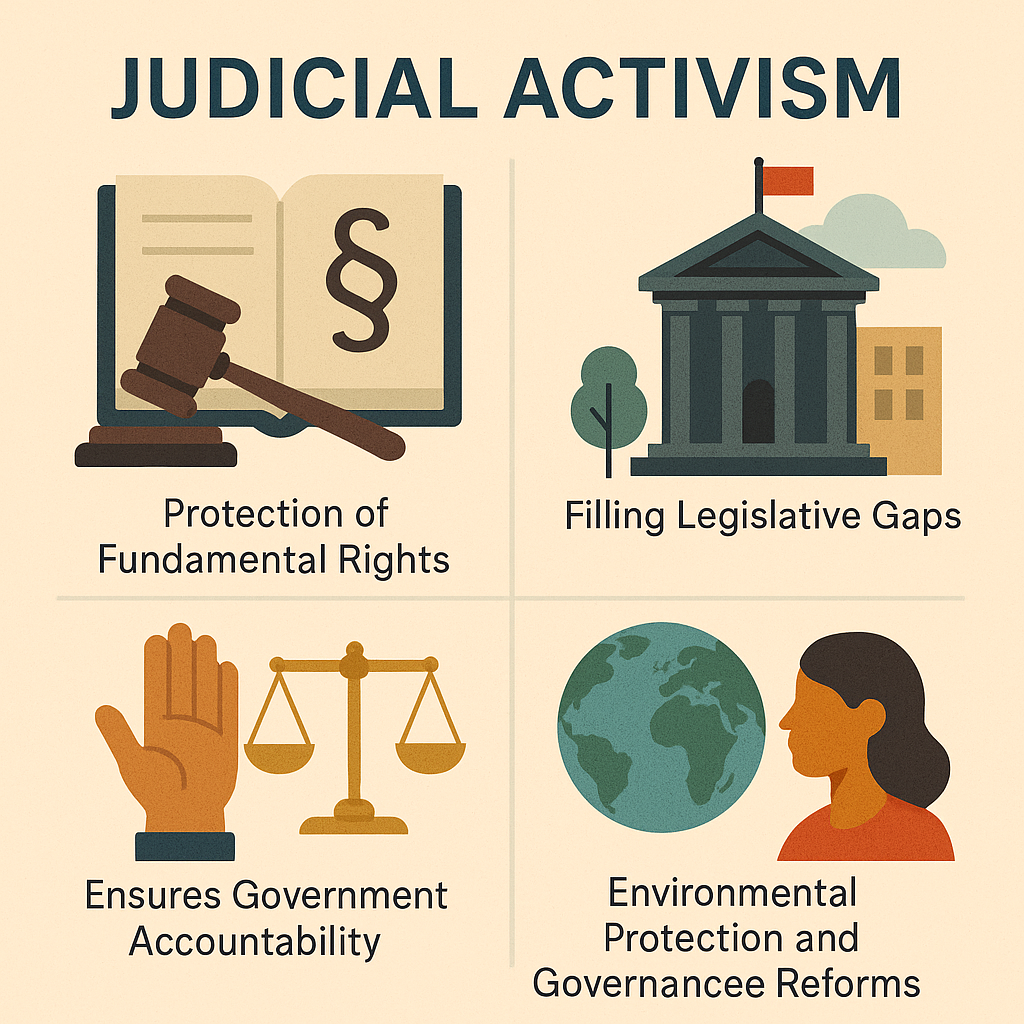
Judicial activism is both necessary and desirable when it:
- Enforces fundamental rights,
- Addresses legislative or executive vacuum,
- Intervenes to prevent manifest injustice.
However, when judicial decisions transform into policy directives or legislative acts, they may cross into adventurism. The judiciary’s credibility depends on its ability to strike this balance—remaining assertive, yet restrained.
Conclusion
Judicial activism has been a cornerstone of India’s constitutional progress, empowering citizens and strengthening democracy. Yet, unrestrained activism risks undermining the very principle of separation of powers that sustains constitutional governance. A measured approach, rooted in constitutional text and spirit, is the key to ensuring that the judiciary continues to function as the guardian of rights without slipping into the domain of governance.
~Varun Rai Saxena (Assistant Professor)
Join SKSIL Law College and gain hands-on experience with the latest legal technology.